Showing posts with label revenge. Show all posts

Wednesday, February 7, 2018

FINISHED:
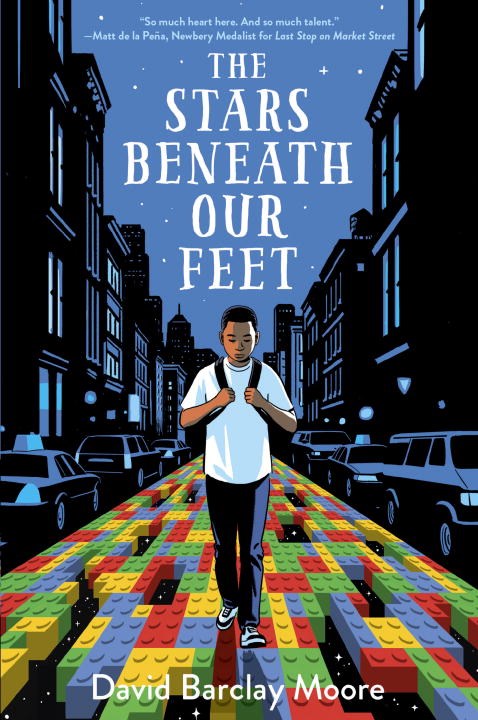
Moore, David Barclay. (2017). The Stars Beneath Our Feet. New York: Knopf.

[.]

STARTED:
Burkey, Mary. (2013). Audiobooks for Youth: a Practical Guide to Sound Literature. Chicago: ALA Editions.

[Gearing up for the ALSC Notable Children's Recordings committee.]

*

Wednesday, January 17, 2018

FINISHED: 
Balliett, Blue. (2018). Out of the Wild Night: A Ghost Story. New York: Scholastic.

[.]

STARTED:
Gemeinhart, Dan. (2018). Good Dog. New York: Scholastic.

[.]

*

Saturday, December 9, 2017

FINISHED: 
Reynolds, Jason. (2017). Long Way Down. New York: Atheneum/Simon & Schuster.

[.]

STARTED:
Snyder, Laurel. (2017). Orphan Island. New York: Walden Pond/HarperCollins.

[Newbery buzz.]

*

Saturday, June 24, 2017

FINISHED: 
Smith, Ronald L. (2017). The Mesmerist. New York: Clarion/Houghton Mifflin Harcourt.

[In Victorian England, 13-year-old, white Jessamine helps her mother in swindling those who wish to contact the dead, and comes to discover that her parents were members of the League of Ravens, a group of folk with special abilities who protected England from an evil necromancer named Mephisto.  When Jess figures out that she, too, has an ability (to read people’s memories) she goes to live with Balthazar, the old head of the League of Ravens, and two other young people with special powers, and the three of them take it upon themselves to banish Mephisto forever when it appears that he has returned and is spreading disease throughout London.  Smith’s follow up to his eerie Hoodoo (Clarion, 2015) is equally creepy, dripping with mood and a heavy sense of foreboding, with tense, claustrophobic battle sequences against ghouls in the newly constructed London Underground, and the repeated use of the rhyme/song “Ring Around the Rosie” that will elicit chills.  When London becomes overrun by a mysterious disease (caused by Mephisto) and townspeople look for a scapegoat, ultimately settling on immigrants (“Foreigners out of our England!”), one can’t help but call to mind Brexit, the “Muslim Ban”, and other similar events in the current tide of nationalism.  This is one that more mature scary story fans should thoroughly enjoy.]

STARTED:
Wolk, Lauren. (2017). Beyond the Bright Sea. New York: Dutton/Penguin Random House.

[Newbery buzz...]

*

Tuesday, May 10, 2016

FINISHED:

Joyce, William. (2016). Ollie's Odyssey. New York: Atheneum/Simon & Schuster.

[.]

STARTED:
Brown, Peter. (2016). The Wild Robot. New York: Little, Brown.

[.]

*

Tuesday, June 21, 2011


FINISHED:
Bulla, Clyde Robert. (1962). The ring and the fire. New York: Thomas Y. Crowell.

[.]

STARTED:
Hardinge, Frances. (2006). Fly by night. New York: HarperCollins.

[.]

*

Monday, September 27, 2010


FINISHED:
Collins, Suzanne. (2010). Mockingjay. New York: Scholastic.

[Not bad... but I just wasn't compelled to tear through it like I was with the previous installments. Yeah, it needed to wrap things up, but it could've used some more of the action and adventure of the first two books. Here, it seemed to me like the action sequences were just stuck in in order to provide sequences that would pick up the pace. Disappointed, but, as with LOST, the journey itself was satisfying enough to justify an unsatisfying ending.]

STARTED:Jinks, Catherine. (2010). The genius wars. New York: Harcourt.

[Reviewing for ACL.]

*

Wednesday, August 11, 2010


FINISHED:
Hahn, Mary Downing. (2010). The ghost of Crutchfield Hall. New York: Clarion/Houghton Mifflin.

[My official ACL review:

Orphan Florence is pulled from the orphanage where she’s been living for the past seven years and whisked away to Crutchfield Hall, a rural gothic mansion where a well-to-do aunt and uncle reside. Florence quickly realizes that all is not well, however, when she discovers that her recently deceased cousin, Sophia, seems to be lingering and has it out for Florence’s ailing cousin James. What’s worse, Sophia’s “death day” is approaching (it’s been a full year since she died) and her influence on Florence is strengthening while Florence finds it harder and harder to resist Sophia’s pull. This is a vivid, if typical, Victorian ghost story steeped in rich language and descriptive passages which give a strong sense of place and mood and, at a brisk 150 pages, would be perfect for those ready to graduate from collections of shorter scary stories. [Reviewed from ARC.]]

STARTED:
Berlin, Eric. (2007). The puzzling world of Winston Breen. New York: Puffin/Penguin.

[Heard it's fun.]

*

Saturday, February 13, 2010


FINISHED:

Stork, Francisco X. (2010). The last summer of the Death Warriors. New York: Arthur A. Levine/Scholastic.


[My review for ACL is forthcoming...]

STARTED:
Byars, Betsy. (1976). The tv kid. New York: Viking.

[I was/still am a TV KID.]

*

Wednesday, December 30, 2009


FINISHED:

Barry, D., & Pearson, R. (2008). Science fair. New York: Disney Editions.


[.]

STARTED:
Benioff, David. (2008). City of thieves. New York: Viking/Penguin.

[Got this for Brian to read because I heard good things about it, but decided to read it as well because I LOVED 25th Hour (the movie).]

*

Thursday, November 5, 2009


FINISHED:

Lieb, Josh. (2009). I am a genius of unspeakable evil and I want to be your class president. New York: Razorbill/Penguin.


[Review forthcoming...

Seventh-grader Oliver Watson has everyone fooled: while it would appear that he’s just shy of being a complete moron, in reality Oliver is the 3rd richest person in the world (although it is a recovering alchoholic named Lionel Sheldrake who acts as figurehead for Oliver’s business dealings) with a secret lair under his parents house and countless minions (many of whom he doesn’t even know) who will do ANYTHING that Oliver wishes with just a whisper. What Oliver wants right now is to be 8th grade class president in order to stick it to his distant father who brags about having been class president back in his schooling days. Former “Daily Show” producer Lieb has crafted a laugh-out-loud debut novel loaded with hilarious footnoted asides, bizarre situations, unbelievable gadgets, and a teacher who Oliver messes with by having messages printed on the teacher’s cigarettes. Although, for many, Oliver may come off as a bit nihilistic, despicable, and narcissistic, he is somewhat redeemed in a heartwarming ending. Perfect for any young adult (or adult) who feels like an outsider and wishes they could rule the world.]

STARTED:
Standiford, Natalie. (2009). How to say goodbye in robot. New York: Scholastic.

[Reviewing for ACL.]

*

Friday, July 24, 2009


FINISHED:

Stroud, Jonathan. (2009). Heroes of the valley. New York: Hyperion.


[LOVED. Recommending for the ACL 2009 Distinguished Books list.

Here's what I wrote for the review:

Many years ago, the twelve House heads of the valley banded together to fight off the evil, subterranean Trow. Now, many years later with the Trow at bay, Halli Sveinsson, a stubby and unattractive youth who happens to be in line for the head of his House, sets out to seek revenge against those from another House in the valley whom he witnessed murdering his uncle. Stroud, author of the celebrated Bartimeaus Trilogy (Hyperion, 2003-2006), has crafted an engaging adventure story brimming with action, intrigue, murder, legend, and mystery that borrows heavily from Viking lore. Surprisingly, there’s also a good amount of humor to be found here which serves to make the characters all the more human and believable. A romance bubbles between Halli and Aud, a young “princess” of her House, and Aud helps Halli to question all that he has been taught about the hero of his house, Svein – whose tales are told at the beginning of each chapter. As it turns out, all of the other Houses in the valley have similar stories about their heroes who participated in the conquering of the Trow, each claiming that their House’s hero was the greatest of them all. In addition, the very existence of the Trow is questioned; although no one has actually seen one in generations, everyone has just taken for granted that they exist based on lore. These plot points bring up the timely and important idea of questioning our heroes and what our elders have always told us to worship or fear. What (or who…) are the real demons that haunt us? And isn’t it true that we don’t have to live in the shadows of our heroes but all have the ability to be ones ourselves?]

STARTED:
Watson, Jude. (2009). Beyond the grave. New York: Scholastic.

[Only on Book #4?!? Not really sure why I keep reading these... I guess I just hope that there will be some big payoff in the end which will make it all worth it. If they weren't so short and light I would've given up a long time ago.]

*
Sunday, March 29, 2009


FINISHED:

Feldman, Jody. (2008). The Gollywhopper games. New York: Greenwillow/HarperCollins.


[Holy cow! Follow the link above to the official website - how fun does THAT look!?!

Total fun, this one! Is it the best book ever? Well, no - the writing and the narrative aren't perfect, but golly-gee it's a compelling bunch of enjoyment. Gil's father was wrongly implicated in an embezzlement scandal at the Golly Toy & Game Company 18 months ago and now he's determined to get his "revenge" by winning a large-scale contest that the toy company is putting on. Gil makes it through the first few rounds of the competition and, as one of the final 10, is invited back to the toy company headquarters to participate in the Gollywhopper Games. Of course, the toy headquarters are an incredible land of large-scale rooms with rainbows, hot-air balloons, snacks, and toys and games galore. Thankfully, the set up is short with the majority being the games themselves. Readers are given the wordgames that the contestants get and can try to figure them out on their own, and there's loads of intrigue and cheating to keep the pace. In a note in the back from the author she says that she was inspired to write the novel after a child in a library asked her for a book that is like Charlie & the Chocolate Factory, and that's pretty much EXACTLY what she has produced here. Sure, it doesn't have the witicism of Dahl's timeless masterpiece, but Feldman does an admirable job. The location, the descriptions of these large rooms and crazy games, the honest boy competing against a couple of creeps, etc. HIGHLY recommended.]

STARTED:
Trueman, Terry. (2000). Stuck in neutral. New York: HarperCollins.

[Recommended by a colleague - looks like a quick read...]

*

Monday, February 9, 2009


FINISHED:

Volponi, Paul. (2008). The hand you're dealt. New York: Atheneum.


[Review will be posted here when I've written it. I can say, though, that I wasn't a huge fan.

You didn't ask for it, but here it is:

Huck, a high school senior, takes part in his town’s annual poker tournament in an effort to exact revenge on last year’s winner, the high school math teacher, Mr. Abbott. The tournament winner gets a watch blessed by the Pope passed to them that they may wear until the next champion is announced – the watch that Abbott had the gaul to steal off the wrist of previous year’s winner: Huck’s father, who was in a coma at the time. There isn’t a whole lot of compelling action, the subplot involving Huck trying to woo a female classmate is thin, and a roaring flash forward at the very beginning of the novel then falls flat without a suitable payoff when the story comes back around to that moment again. Although the Texas hold-em’ variation of poker is described early on in terms of how cards are dealt, there is never any explanation of how poker itself is played, thus rendering those without any knowledge of the game/sport shut out of the action. Further, the Abbott character is over-drawn as a villain, boasting, complaining, and even going so far as to trick kids in his classroom into thinking they are doing poorly while taking math tests – he’s just too much of a horrible teacher to be believed. While this one may appeal to those young adults or reluctant readers looking for a brisk read and caught up in the current popularity of televised poker tournaments, all others are advised to place their bets elsewhere.]

STARTED:
Urban, Linda. (2007). A crooked kind of perfect. Orlando, FL: Harcourt, Inc.

[At the Distinguished Books round-up last weekend, when this book was brought up there was an overwhelming positive buzz about this one. Next to the name of this one on the list I wrote "READ IT".]

*

Sunday, September 7, 2008


FINISHED:

Jinks, Catherine. (2008). Genius squad. Orlando, FL: Harcourt.


[Will post ACL review when it appears.

And away we go:

Cadel, a teenage computer whiz, is moved from his current foster home to a group home that acts as a front for an organization of young hackers determined to bring down GenoME, a project believed to be led by Dr. Darkkon, an evil man bent on dominating the world. Even though he is under 24 hour police protection surveillance, Cadel is constantly worried that a man linked to Darkkon, and who may very well be his father, will stop at nothing to come and take him away. While having to keep up appearances as a group foster home so as not to be detected by the police, Cadel and the other odd assortment of hackers known as the Genius Squad tap into computers, spy on others by listening to keyboard key strokes, and travel around in disguises. This is a surprisingly compelling and fast-paced read despite what could be dry and technical subject matter, and Jinks has created a number of interesting characters who are co-hackers. One of the more memorable characters is Cadel’s best friend Sonia who has Cerebral Palsey and is confined to a wheelchair with her only means of communication being a touchpad with a computer voice. Jinks’ handling of Sonia is a masterstroke, bringing only as much attention to the character as she does any of the others, and a subplot involving Cadel’s social worker and the main detective inspector on Cadel’s case, while not surprising, is sweet. There is a lot going on here, including many names to keep track of, most of whom it seems figured into the first book in this series, Evil Genius (Harcourt, 2007), which, to some degree, ought to be read first in order to get up to speed. In addition, there is SO much computer jargon and many technical descriptions of situations where the hackers are doing their thing that this tome would be best enjoyed by those young people who have a good knowledge of the ins and outs of computers.]

STARTED:
Harmon, Michael. (2008). The last exit to normal. New York: Alfred A. Knopf.

[For ACL review.]

*

Sunday, August 24, 2008


FINISHED:

Cormier, Robert. (1974). The chocolate war. New York: Knopf/Random House.


[In looking for a link to something interesting about the book online, I came across a petition to have the book removed from a middle school reading list - this just BURNS MY BRITCHES. People who signed the petition actually wrote stuff like "this book is satanic" and "obviously these people do not believe in God". AAAARGH..]

STARTED:
Scott, Michael. (2007). The alchemyst: The secrets of the immortal Nicholas Flamel. New York: Delacorte/Random House.

[.]

*

Monday, June 16, 2008


FINISHED:

Fleischman, Sid. (2008). The entertainer and the dybbuk. New York: Greenwillow/HarperCollins.


[This one was GREAT! Freddie is a ventriloquist in post-WWII Europe who has trouble getting gigs because... well... his lips clearly move during his act. Suddenly, one day, a voice comes out of him that is not his own, but the ghost of a young Jewish boy who was shot dead by a Nazi officer. Freddie and the dybbuk (the ghost boy who is possessing Freddie) work out a deal where the dybbuk provides the voice for the ventriloquist dummy while Freddie astonishes audience by drinking and whistling and making the dummy talk at the same time. The dybbuk promises Freddie he'll move on once he gets his revenge on the Nazi who killed him, so Freddie travels to the U.S. where the officer is on trial for murder under an assumed identity. A startling examination of post-Nazi Europe for young people, this is certain to be one of the best books of the year. Oh, and just LOOK at that cover! A dummy with a Jewish star on his arm and a smoking (and BLEEDING!) bullet hole right through his chest. Fleischman scores again!]


STARTED:
Clements, Andrew. (2004). The report card. New York: Aladdin/Simon & Schuster.

[I've liked the other books by Clements that I've read, so I decided to pick up another one. This one intrigued me because it's supposed to be about a kid who wants grades done away with.]

*

Wednesday, June 4, 2008


FINISHED:

Marriott, Zoe. (2008). The swan kingdom. Cambridge, MA: Candlewick Press.


[Liked it, but thought that it dragged in the middle. Lots of stunning descriptions, but not a whole lot of dialogue to move things along. Will post my ACL review when it is finished...

And here it is:

After her mother, Queen of the Kingdom, is viciously mauled to death by a mysterious beast, Alexandra’s father suddenly marries a woman who seems to have all of the Kingdom locked in a spell. Alexandra is then sent to another land to live with her aunt, all the while trying to get back and find her three older brothers who have all disappeared – most likely turned into swans. Loosely based on Hans Christian Andersen’s tale “The Wild Swans” (first published in 1838), Marriott’s take plays out as an extended fairy tale for a new generation of readers. Loaded with stunningly descriptive passages, the novel actually feels a bit heavy in this regard with very little narrative action. As Alexandra is making her way back to the Kingdom, there are whole sections without any dialogue at all to move things forward as Alexandra can not speak or else she’ll ruin a spell to save her brothers. This all serves to make the ending somewhat anticlimatic compared to all that comes before it. Still, the language is lovely, and fans of fairy tale fantasy with strong female protagonists will be delighted.]


STARTED:
Bray, Libba. (2007). The sweet far thing. New York: Delacorte/Random House.

[Reading this one to see if I deem it "outstanding" for ACL. At over 800 pages, it's a BEAST.]


STARTED & FINISHED:

Stamaty, Mark Alan. (2004). Alia's mission: Saving the books of Iraq. New York: Alfred A. Knopf.


[Read this one for obvious reasons. Such an amazing and inspiring story about a woman who feels so passionately about books and preserving history that she moves books out of the library in Basra and into her home in an effort to save them from possible bombing. Presented in a fantastic comic book/graphic novel format which ought to attract young ones to this story of bravery during wartime.]


Holm, Jennifer L., and Matthew Holm. (2007). Babymouse: puppy love. New York: Random House.


[Another great Babymouse adventure. In this one she goes through a series of pets (which all end up "lost" under her bed where they have a party together) before bringing home, caring for, and training a lost dog. FUNNY FUNNY FUNNY. The Babymouse series continues to please.]


Harper, Charise Mericle. (2005). Fashion Kitty. New York: Hyperion.


[Just couldn't resist this one - was especially drawn in by the glitter on the cover. A funny little graphic novel about a cat who realizes that she has special powers - especially the power to help people who are having a "fashion emergency". Had a bit of trouble telling one character from the other, but it was a swift little treat. Comes with mix and match panels in the middle.]

*

Saturday, March 1, 2008


FINISHED:

MacLeod, Doug. (2006/2007). I'm being stalked by a moonshadow. Honesdale, PA: Front Street/Boyds Mills.


[Will post my ACL review when it's finished. And, here it is:

While “rendering” their house out of animal manure, Seth, an Australian teen, and his hippie parents find themselves at odds with the town environmental health officer, Mr. Raven, setting off an ongoing feud between Seth’s father and the official. Naturally, Seth, a budding playwright who is unnaturally preoccupied with muscles on women, falls for Mr. Raven’s daughter, Miranda, hoping to woo her by following a list of “22 Ways to Know If He Is Mr. Right” (included in an appendix at the end of the novel) which he finds in a copy of a girls’ magazine. Though this is little more than a typical “wacky stories in a teen’s slice of life” novel, it should be noted that the humor here is often wonderfully dry and some of the supporting characters, especially Seth’s brother – a fingernail-painting hypochondriac who believes he may be a nudist – and members of Seth’s drama class, are humorously drawn with consistent wit. Hardly anything out of the ordinary, this is still a charming little novel, first published in Australia in 2006, that ought to leave any reader occasionally chuckling out loud. Included in this U.S. edition is a forward from the author titled “A Warning to Americans” explaining some Australian colloquialisms.]


STARTED:
Price, Charlie. (2007). Lizard people. New York: Roaring Brook.

[Also reviewing for ACL. Trying to actually get them done well before the next meeting...]

*